


Page 166 - Freshwater-Biology-and-Ecology-Handbook
P. 166
CHAPTER 3     4.1                               4


                          RIVER INVERTEBRATE STATUS

                              CLASSIFICATION IN THE UK


            4.1  Overview


            There are currently two statutory river invertebrate quality   database and development reports are available from
            classifications in the UK: the general quality assessment   the RICT website at: https://www.fba.org.uk/other-
            described here and another specifically for acidification.  scientific-collaborations/rivpacs-and-rict The software
                                                              is written in R and can be downloaded from the website or
            The acidification classification is only used to assess   run as a web application.
            river status in Scotland and Wales, although it is used
            for investigations in England. Reference values for this   You can download the RIVPACS reference database from:
            classification are not based on RIVPACS but on the   https://www.fba.org.uk/rivpacs-and-rict/rivpacs-rict-
            susceptibility of sites to acidification from acid deposition.    resources This lists the species found in all the RIVPACS
            It is described in Section 6.                     reference samples and their abundances, biotic indices
                                                              derived from them, and the averages of these vaues across
            The River Invertebrate Classification Tool Version 2   sites in each ‘end group’ (known as end-group means),
            (RICT2) software, released in 2020, not only implements   which RIVPACS uses in its agorithms to predict them.
            the current version of RIVPACS (RIVPACS IV) but
            also calculates the general river invertebrate status   The flow diagram in Figure 3.18 describes the classification
            classification. The software, user guides, reference   process from sample collection to data analysis.


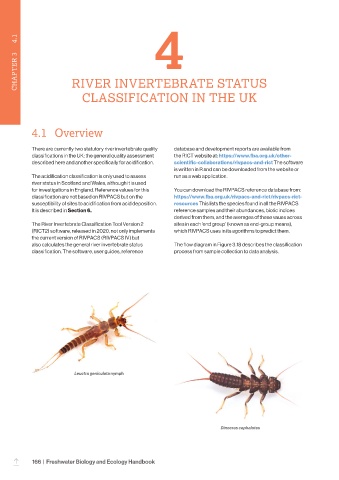
                           Leuctra geniculata nymph


                                                                               Dinocras cephalotes


            166  |  Freshwater Biology and Ecology Handbook
      –

