


Page 165 - Freshwater-Biology-and-Ecology-Handbook
P. 165
3.3.2  Conversion of

            adjusted predictions to

            reference values


            This step is to convert the adjusted prediction from a
            value representing the High/Good boundary to a value
            representing the WFD reference condition – ie to a WFD
            reference value (Figure 3.16). The WFD reference value of
            an index is defined as its median value at WFD reference
            sites (sites that comply with WFD reference criteria) and it
            is somewhere in High status. The conversion factor is the
            ratio of the median value of the index across all RIVPACS
            reference sites (both GB and NI models) to the median of
            the value from RIVPACS reference sites that are also in
            WFD reference condition.
            Ideally, we would have derived separate conversion
            factors for each end group, but that was not possible
            because, in some end groups, none of the reference sites
            were in reference condition. The effect of conversion is
            relatively small, but it does ensure that, as a whole, the
            UK’s river invertebrate classification is equivalent to those
            used in other countries.
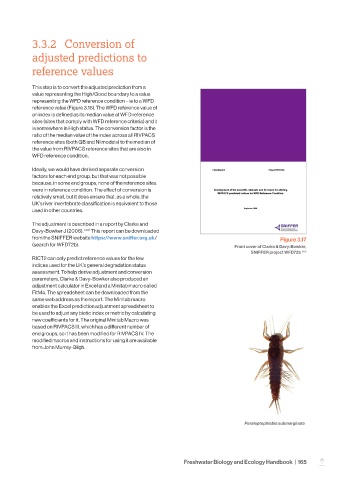
            The adjustment is described in a report by Clarke and
            Davy-Bowker J (2006).  (49)  This report can be downloaded
            from the SNIFFER website https://www.sniffer.org.uk/                                   Figure 3.17
            (search for WFD72b).                                                   Front cover of Clarke & Davy-Bowker,
                                                                                         SNIFFER project WFD72b  (49)
            RICT2 can only predict reference values for the few
            indices used for the UK’s general degradation status
            assessment. To help derive adjustment and conversion
            parameters, Clarke & Davy-Bowker also produced an
            adjustment calculator in Excel and a Minitab macro called
            FitM4. The spreadsheet can be downloaded from the
            same web address as the report. The Minitab macro
            enables the Excel prediction adjustment spreadsheet to
            be used to adjust any biotic index or metric by calculating
            new coefficients for it. The original Minitab Macro was
            based on RIVPACS III, which has a different number of
            end groups, so it has been modified for RIVPACS IV. The
            modified macros and instructions for using it are available
            from John Murray-Bligh.


                                                                                       Paraleptophlebia submarginata


                                                                  Freshwater Biology and Ecology Handbook  |  165
                                                                                                                 –

